
When Realities Begin to Overlap
Rhelon did not feel the moment he left the collapsing city.
He felt only the absence of it.
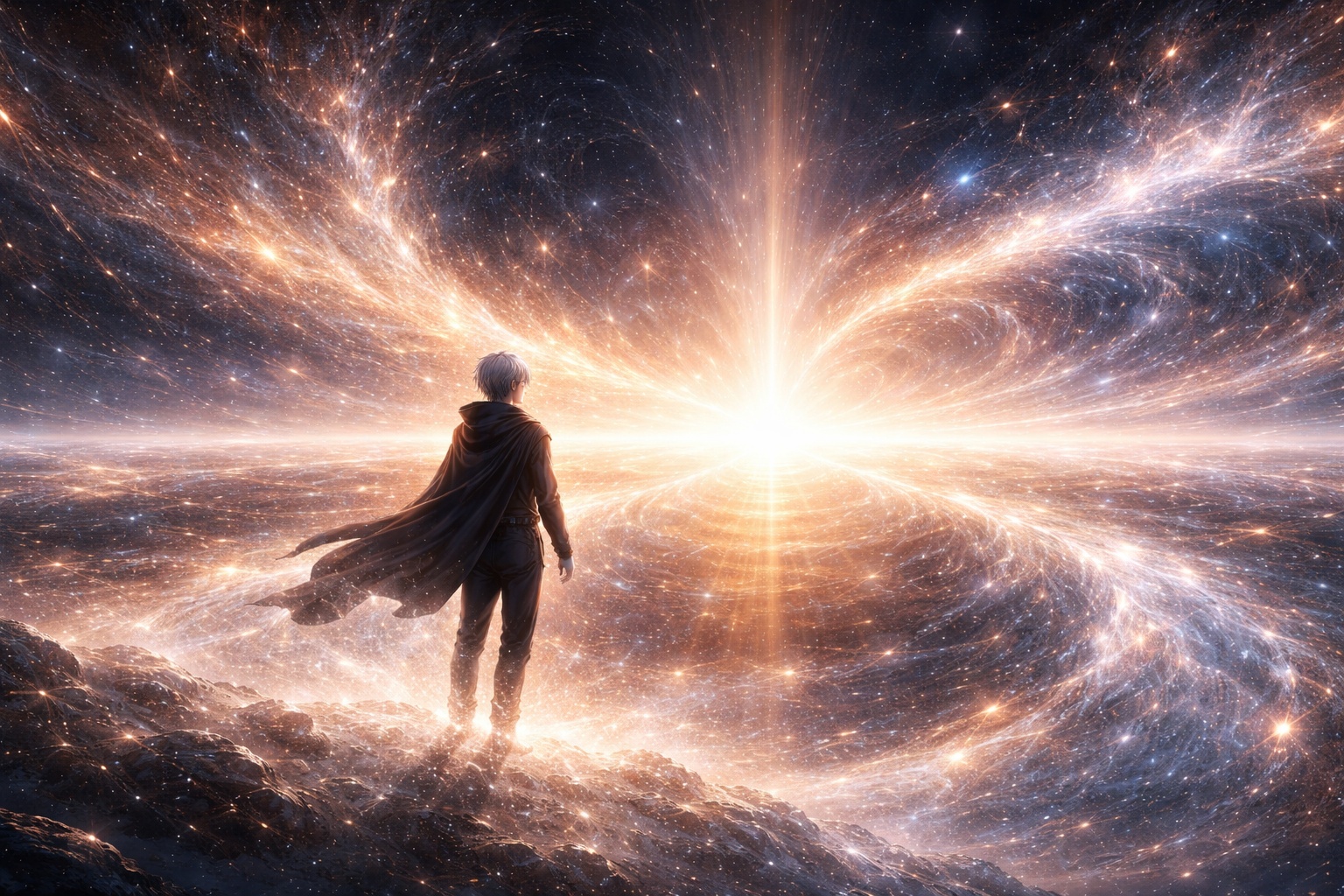
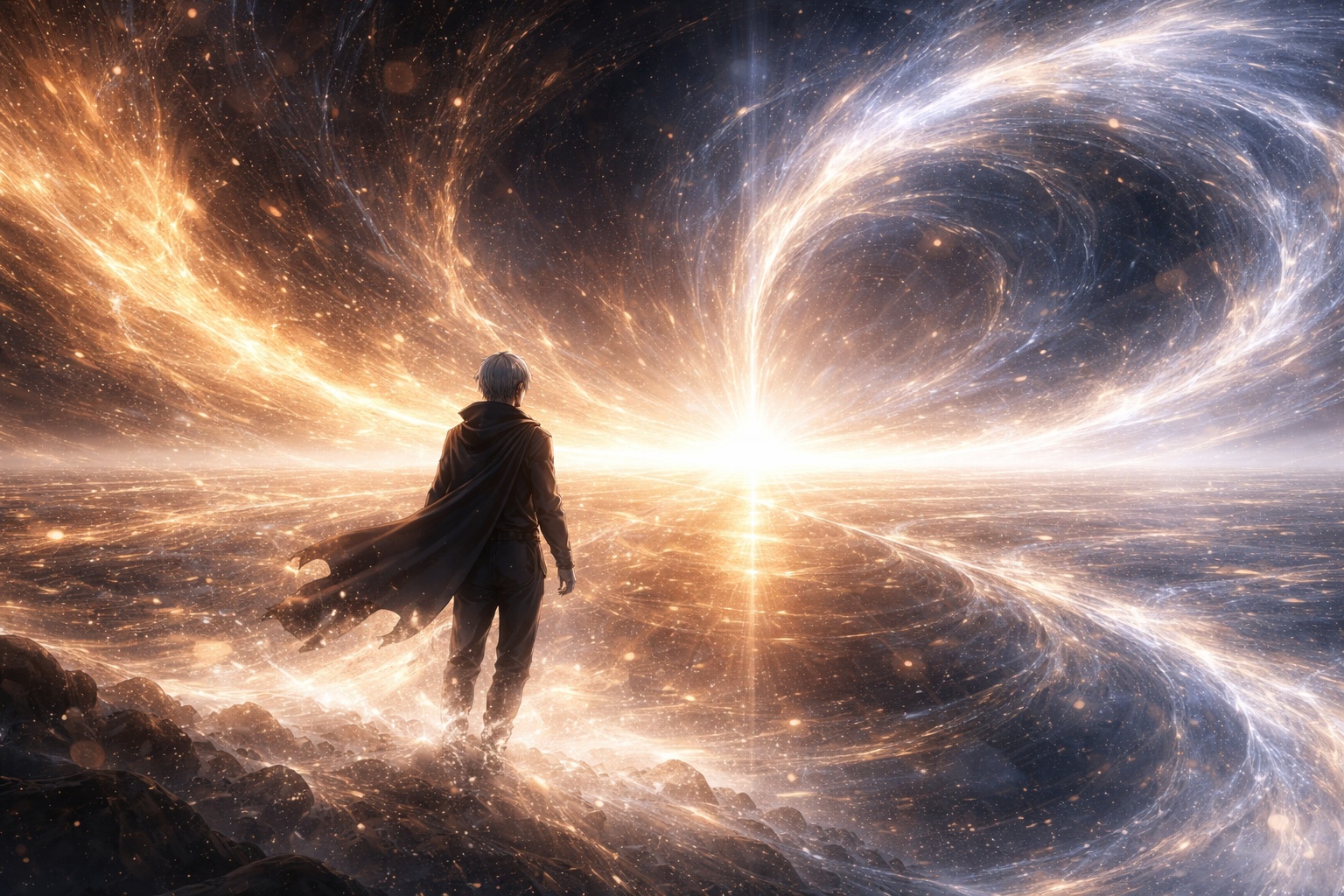
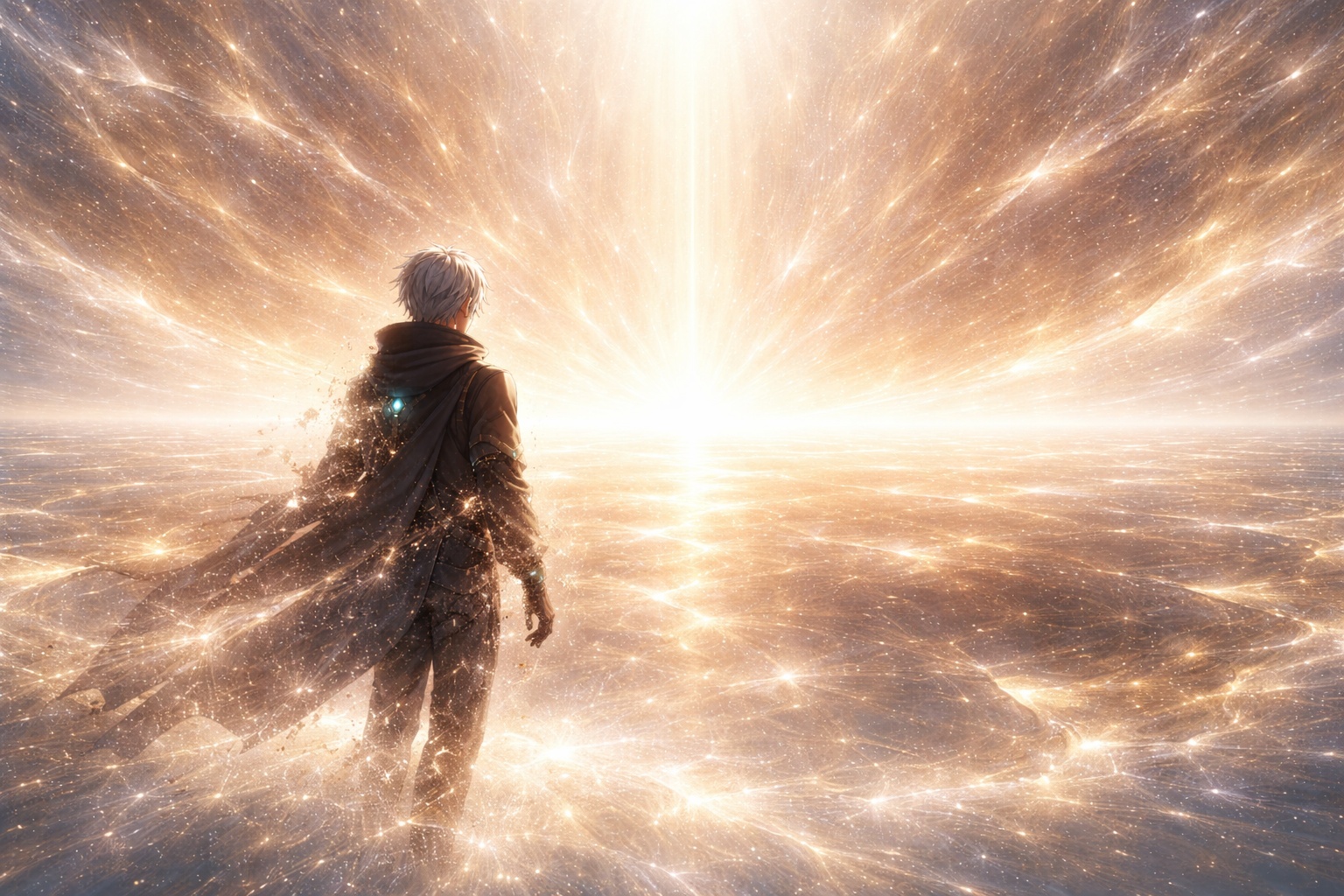
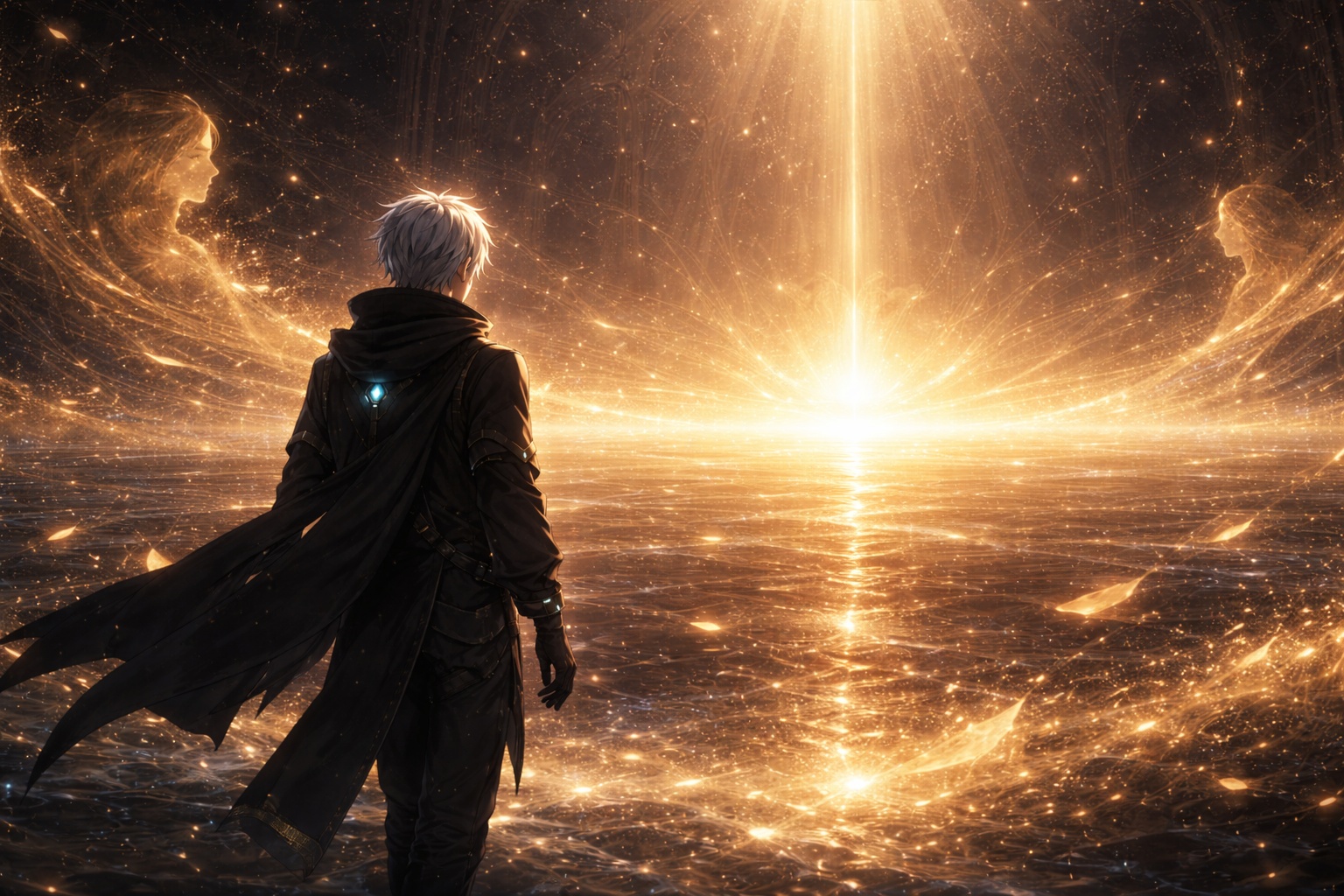
One instant, there had been streets, voices, the fragile existence of a world sustained by memory; the next, there was only the vast lattice once more—threads of light stretching endlessly across a sky that no longer belonged to any single reality. Yet something had changed. The lattice was no longer calm. It pulsed with an uneven rhythm, like a mind overwhelmed by too many thoughts at once, each thread vibrating with a quiet urgency that could not be contained.
Rhelon stood at the intersection where several of those threads converged, his gaze fixed upward as the structure of the universe revealed its instability more clearly than before. Where once the threads had merely crossed, now they lingered against each other, pressing, overlapping, refusing to separate cleanly. Entire worlds brushed against one another, their boundaries thinning until the distinction between them began to blur.
He could feel it.
Not with his senses, but with something deeper—something tied to the Echo Seed within his chest.
The realities were no longer content to exist side by side.
They were beginning to compete.
Lyr stood a short distance away, her presence quieter than usual, as though even she was uncertain how to interpret what was unfolding. “It’s accelerating,” she said softly, though her voice carried further than it should have in a space that had no air to carry sound. “The more realities exist, the more they push against each other.”
Rhelon did not respond immediately. His attention was drawn to a distant section of the lattice where several threads had begun to twist together in a tight spiral. The light there intensified, growing unstable, as if the universe itself were struggling to decide which version of truth should remain.
“What happens,” he asked at last, “when they can’t decide?”
Lyr’s answer came without hesitation.
“One survives.”
The First Collapse
The spiral tightened.
Rhelon watched as two realities converged within that distant intersection, their structures overlapping with increasing intensity. For a brief moment, it was almost beautiful—two worlds merging into a single, luminous possibility. But the beauty did not last.
The light fractured.
A sharp distortion rippled outward, bending the surrounding threads as though they had been struck by an unseen force. Then, without warning, one of the realities dimmed. Not gradually, not gently, but with an abrupt finality that left no space for resistance.
It simply ceased.
The remaining thread stabilized, its glow strengthening as though it had absorbed what the other had lost.
Rhelon felt the impact echo through him, a quiet shock that settled somewhere deep within his chest. He had witnessed destruction before—worlds collapsing, systems breaking—but this was different. There was no violence here, no explosion, no visible ruin.
Only erasure.
“Memory chooses,” he murmured, though he was not entirely certain whether the thought was his own.
Lyr shook her head slowly. “No,” she said. “Memory doesn’t choose. It… persists.”
Rhelon frowned, but before he could respond, the lattice shifted again.
This time, the movement was not distant.
It was everywhere.
The Emergence of the Mirror Armies
Threads began to fracture across the entire network, their intersections multiplying faster than the eye could follow. Where they crossed, reflections appeared—not perfect copies, but distorted versions of what once was. Figures moved within those reflections, their forms incomplete, their movements slightly out of sync with the realities they mirrored.
At first, Rhelon thought they were echoes.
Residual impressions of lives that had already faded.
But as he watched more closely, he realized they were something else entirely.
They were constructed.
Shapes pulled from memory, rearranged, redefined—given just enough structure to exist, but not enough to be real.
“Do you see them?” Lyr asked, her voice quieter now, almost cautious.
Rhelon nodded.
“They’re not worlds,” he said. “They’re… fragments.”
The reflections began to step out from the threads.
Not physically, not in the way a body moves through space, but in a manner that defied simple description—like an image peeling itself away from the surface of a mirror. One by one, they took form upon the lattice, their shapes becoming clearer, more defined, until they resembled people.
Or what people used to be.
Their faces were familiar.
Too familiar.
Rhelon felt a sudden chill as he recognized them—not as individuals he knew, but as variations of something he had already encountered.
Different versions.
Different possibilities.
Different truths.
“They’re made from conflicting memories,” he said slowly.
“And from what those memories refuse to accept,” a voice replied.
The Return of Echo Kaelis
The voice did not come from the air.
It emerged from the reflections themselves, echoing through every distorted surface at once.
Rhelon’s gaze sharpened.
“Kaelis.”
The reflections shifted, aligning briefly into a single, coherent form before fracturing again. For an instant, Rhelon could almost see him—the outline of a presence that no longer had a true body, yet still possessed a will strong enough to shape what remained of it.
“Echo Kaelis,” the voice corrected, though there was no pride in the distinction.
“You’re doing this,” Rhelon said, his tone steady but firm. “You’re shaping them.”
A pause followed.
Not denial.
Not confirmation.
Then—
“I am guiding what already exists.”
Rhelon’s jaw tightened.
“These aren’t just echoes,” he said. “They’re weapons.”
The reflections moved again, their forms stabilizing further, their movements becoming more deliberate. They no longer resembled passive remnants of memory. They were organizing, aligning, forming patterns that suggested purpose.
“Reality requires structure,” Echo Kaelis replied. “Without it, the lattice will collapse into chaos.”
“And this is your solution?” Rhelon asked.
“To impose order on what refuses to be ordered?”
The voice softened slightly, though its underlying logic remained unshaken.
“These are Mirror Armies,” it said. “Constructs formed from incompatible truths. They cannot coexist within a single reality, so they must be resolved.”
“Resolved,” Rhelon repeated quietly.
The word lingered, heavy with implication.
A War Without Sound
The first movement was almost imperceptible.
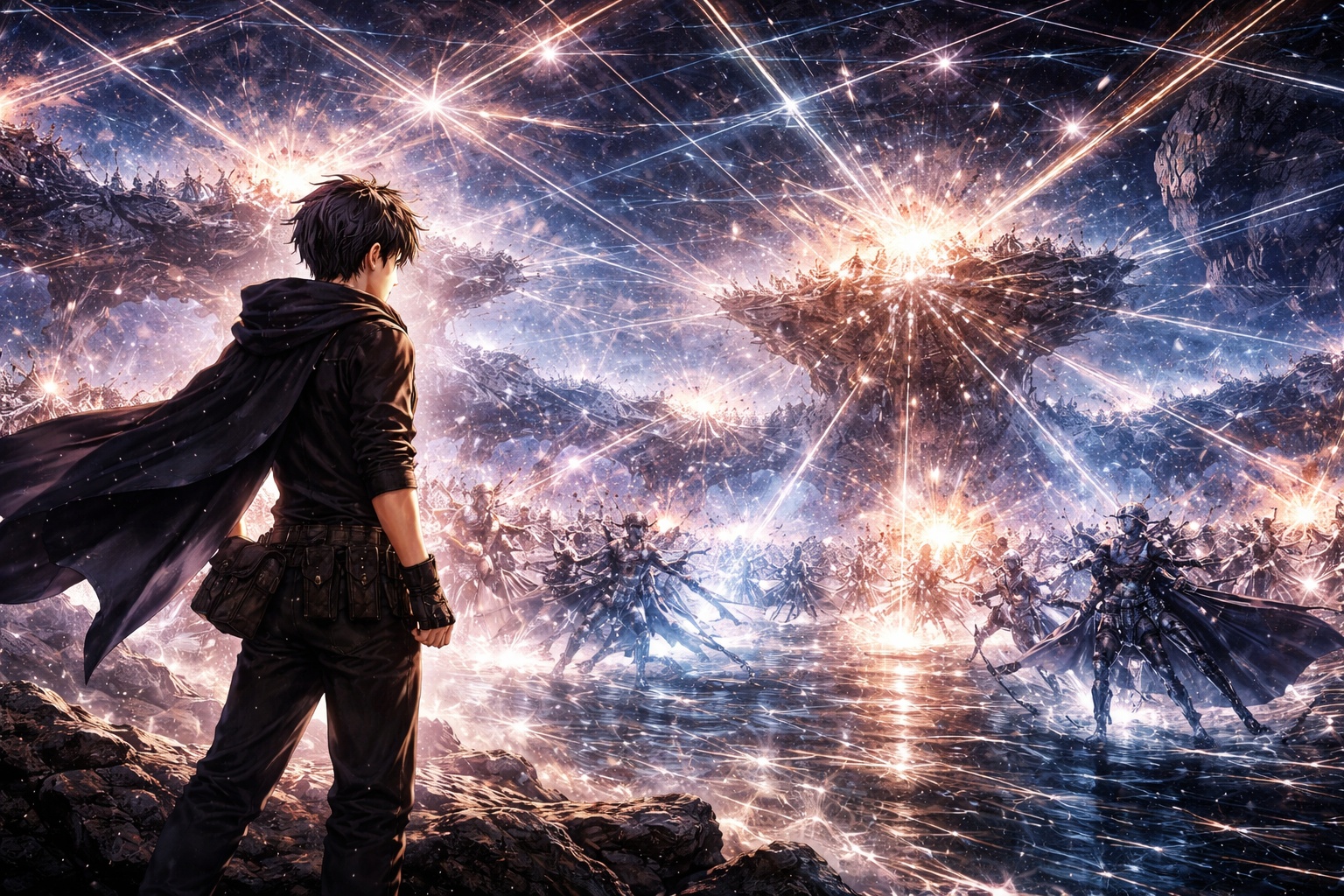
Two Mirror Armies, drawn from different threads, approached the same intersection. Their forms flickered as they advanced, their identities shifting between possibilities that could not fully stabilize. For a moment, they stood facing each other—silent, unmoving, like reflections waiting for something to define them.
Then they collided.
There was no sound.
No clash of weapons.
Only light.
The moment of impact sent a ripple through the lattice, bending nearby threads as the two forces attempted to overwrite one another. Figures blurred, merged, split apart again, their forms dissolving and reforming in rapid succession as each tried to assert its version of truth.
Rhelon felt the strain of it—not as physical pressure, but as something pressing against his mind, forcing him to perceive multiple realities at once.
He took a step back.
“This isn’t a battle,” he said, his voice strained.
“It’s… a contradiction.”
Lyr’s gaze remained fixed on the collision.
“Yes,” she said quietly. “And only one contradiction can survive.”
The light intensified.
Then, as before, one side dimmed.
Faded.
Vanished.
The other stabilized, its form becoming clearer, more defined, as though it had inherited the certainty of what it had replaced.
Rhelon exhaled slowly.
The pattern was undeniable now.
This was not random destruction.
It was a system.
A method.
A war fought not with force, but with truth itself.
The Weight of Choice
Rhelon stood in silence as the lattice continued to shift around him, its countless intersections now alive with conflict. Everywhere he looked, realities overlapped, collided, and resolved into singular outcomes, each one leaving behind a slightly more stable—but increasingly limited—version of existence.
He could feel the Echo Seed responding.
Not passively.
But actively.
As if it were waiting.
For him.
“Why are you showing me this?” he asked at last.
The answer came not from Echo Kaelis, but from within himself.
Because you are the center.
Rhelon closed his eyes briefly, the realization settling into something deeper than thought. He had believed, until now, that he was merely witnessing the consequences of the universe’s rebirth. That his role was to understand, to observe, to navigate what had already begun.
But that was no longer true.
The lattice did not simply surround him.
It responded to him.
Every intersection.
Every conflict.
Every collapsing reality.
They were not just happening around him.
They were waiting for his decision.
Rhelon opened his eyes again, his gaze steady now, though the weight within his chest had grown heavier.
“This isn’t just a war between realities,” he said quietly.
“No,” Lyr replied.
“It’s a war of memory.”
Rhelon nodded.
Then, after a moment—
“A war of will.”