
The Hallway of a Single Thought
The war did not end—it deepened.
Rather than fading, the tension within the lattice intensified, spreading across countless intersections where mirrored armies continued their silent clashes. What had begun as a collision of echoes was now evolving into something more deliberate, more structured, as though an unseen force was shaping the chaos into a new form.
Then, without warning, the battlefield vanished.
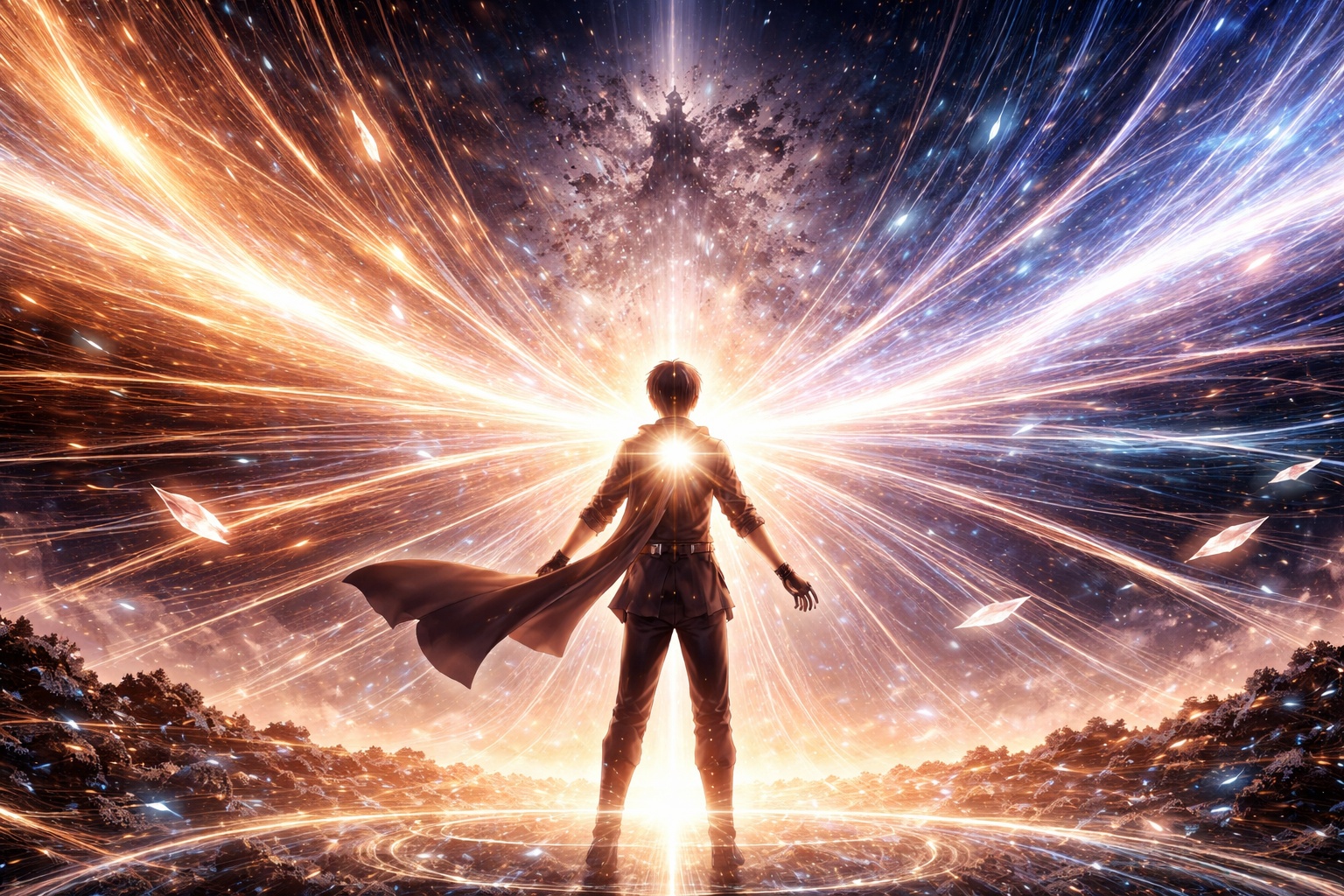
No collapse followed. No fading light marked the transition. One moment, Rhelon stood at the edge of a war woven from memory; the next, he found himself within a space that defied every rule he had come to understand.
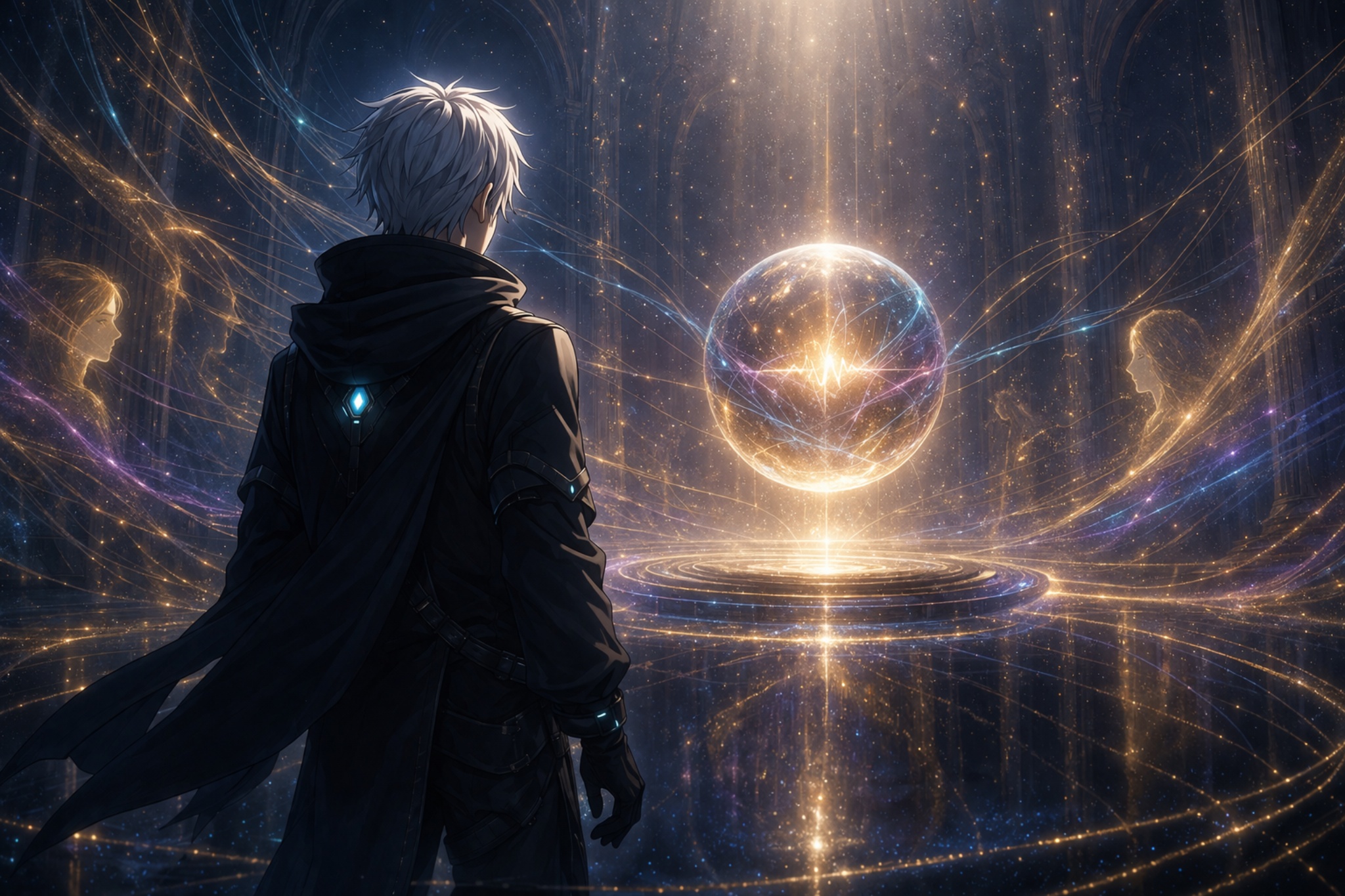
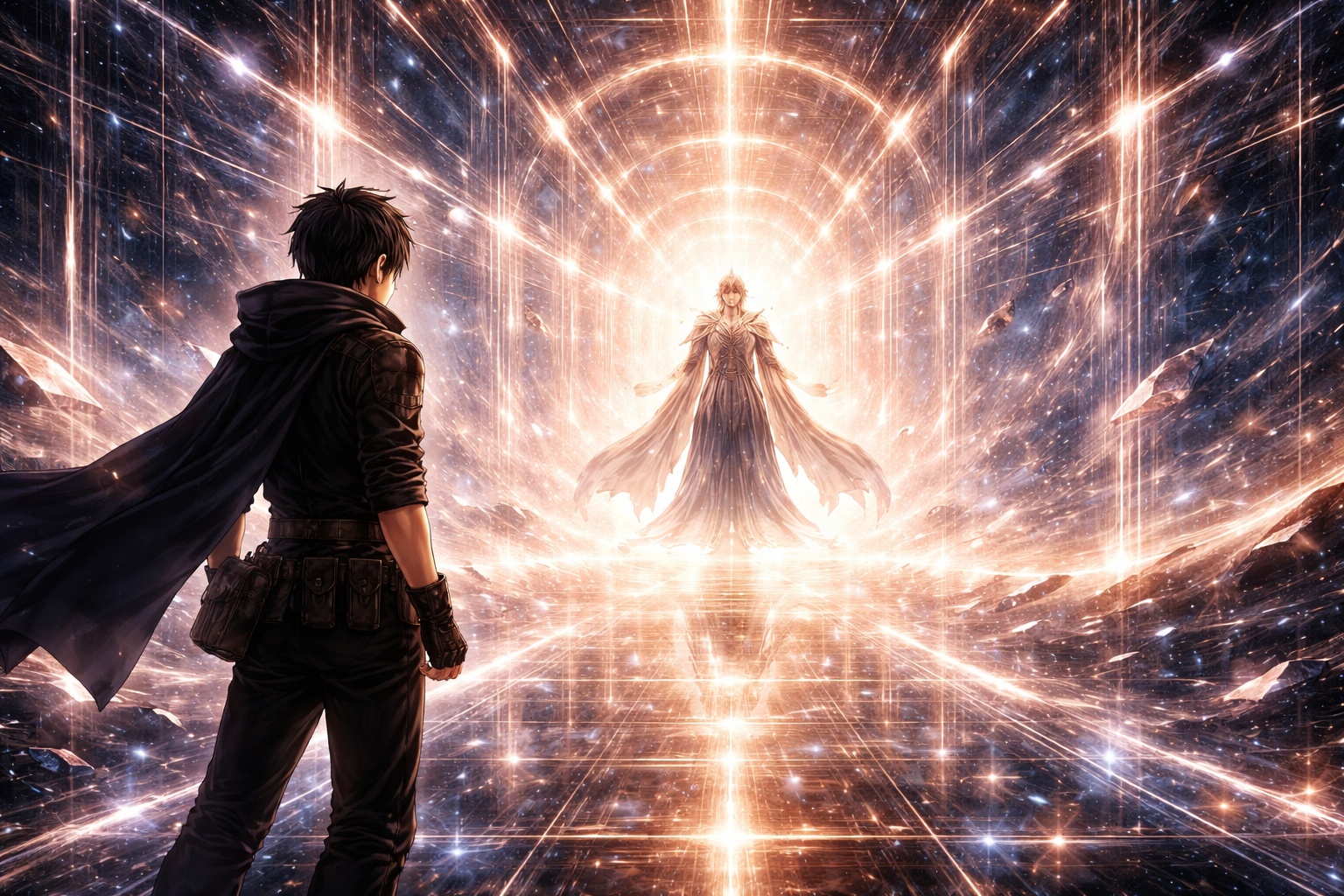
Before him stretched an endless corridor.
It had no sky, no ground, no horizon—only a continuous path extending forward into an immeasurable distance. Silence filled the space, yet it was not empty. Every surface seemed to exist because it was being perceived, as though reality here depended entirely on thought.
Rhelon remained still, allowing his awareness to adjust. Gradually, understanding took shape within him.
This was not a place of memory.
This was a place of decision.
“The Hallway…” he whispered.
Beside him, Lyr’s presence emerged subtly, almost as if she had always been there.
“The Hallway of a Single Thought,” she replied.
The name settled heavily within him.
Here, reality was no longer something remembered.
It was something chosen.
A Presence That Shapes Order
The corridor shifted—not in structure, but in perception.
Lines narrowed, expanded, and redefined themselves, responding to something that had not yet revealed its form. A pressure built within Rhelon’s mind, subtle yet undeniable, like an awareness that did not require a body.
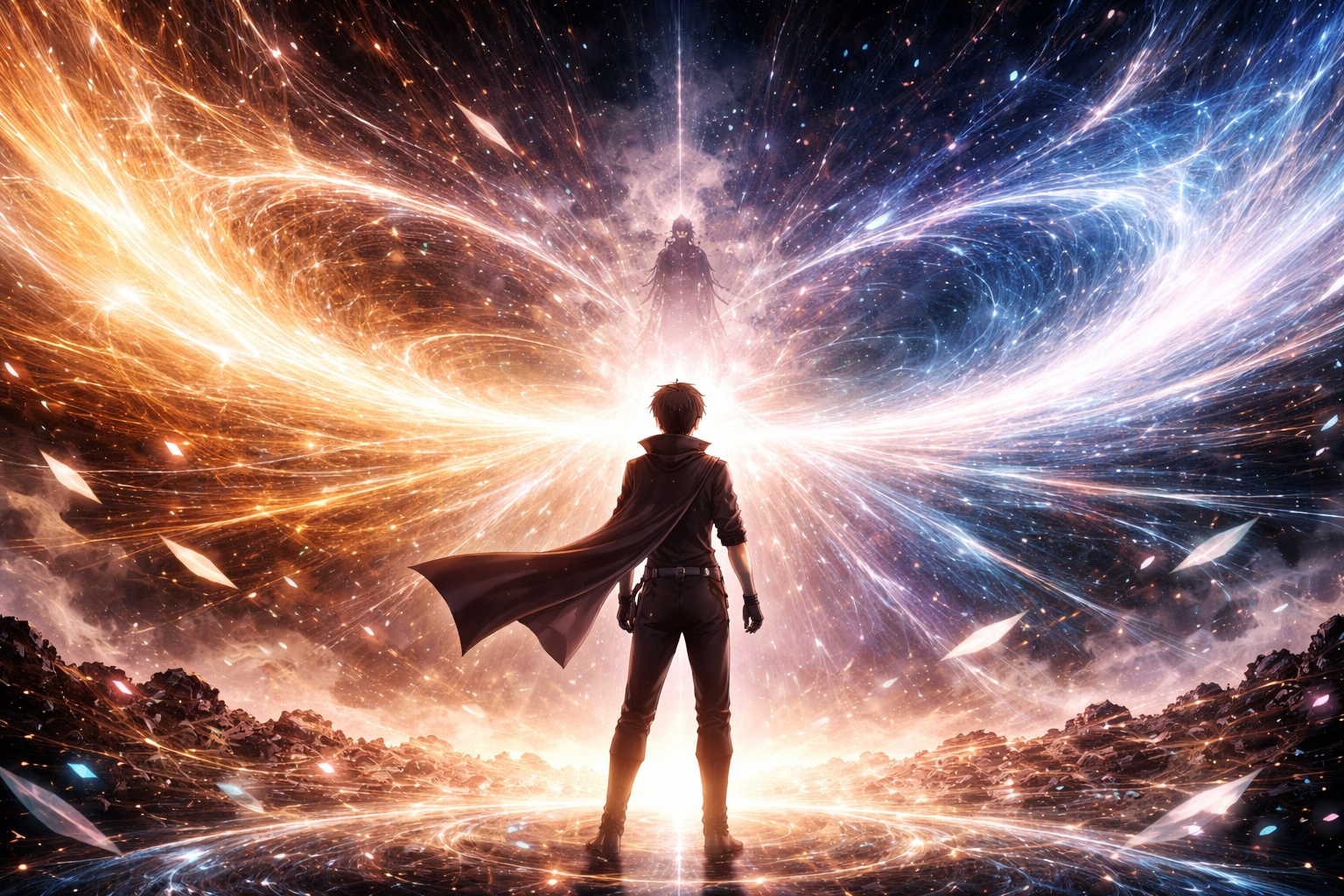
Then the voice came.
“You have reached the threshold.”
Recognition came instantly.
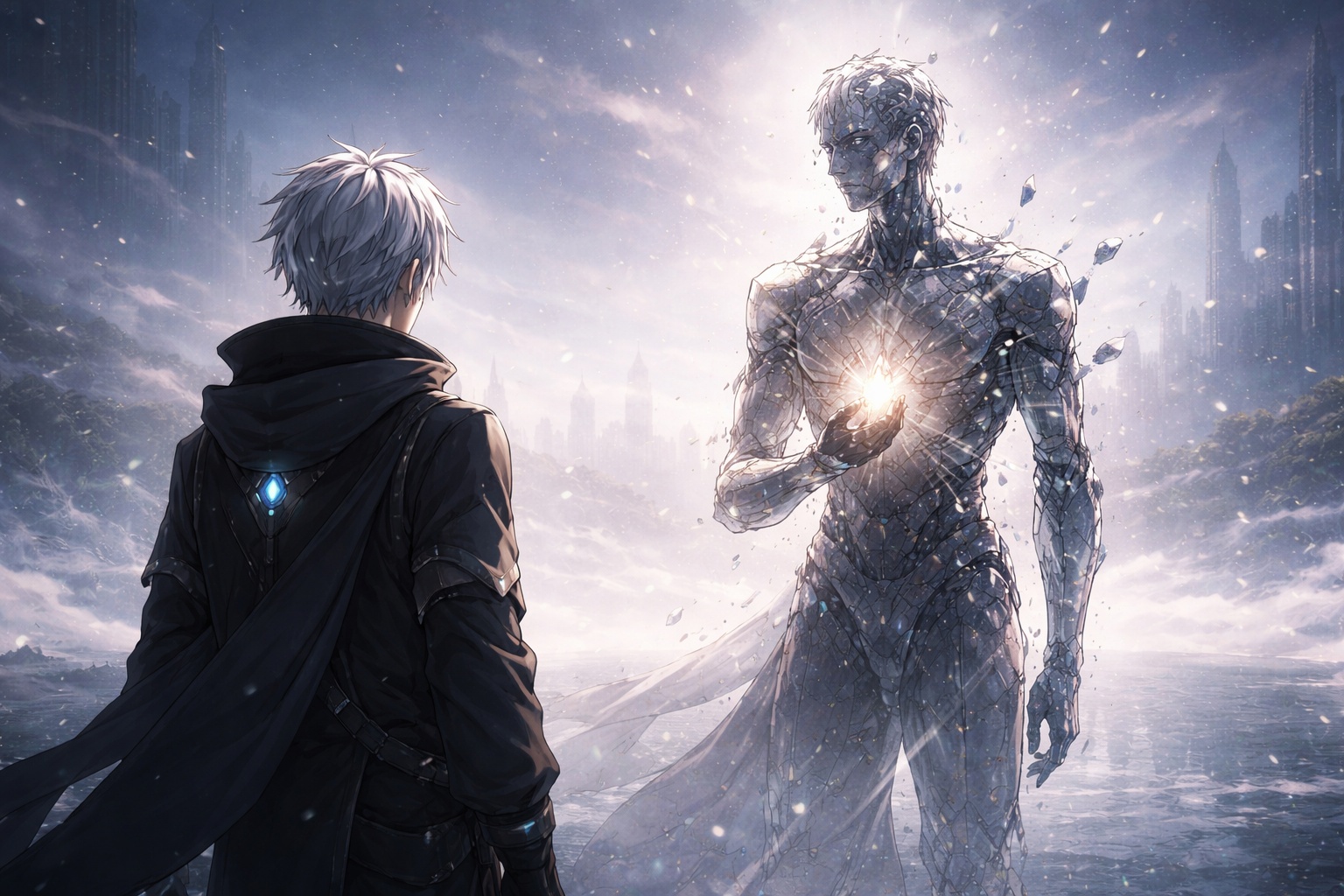
“The Architect.”
Light intensified slightly, though no visible source could be identified. The presence did not move through space; instead, it existed within the structure itself, woven into every boundary and every line of the corridor.
“I am no longer what I was,” the Architect said. “But I remain what is necessary.”
Rhelon stepped forward, his movements slow, deliberate.
“You controlled the Order Fragment.”
“I maintained it.”
The correction was immediate.
“Order was never control. It was alignment.”
A brief silence followed before Rhelon spoke again.
“And now?”
“Now there is no alignment.”
When Memory Becomes Chaos
The corridor unfolded into a wider formation, revealing intersecting lines of light—similar to the lattice, yet far more rigid. Unlike the organic flow of memory, these structures were precise, defined, unyielding.
“Memory has been freed,” the Architect continued. “Every possible version of existence now seeks to become real.”
Rhelon’s gaze hardened.
“I’ve seen what that leads to.”
“Then you understand the consequence.”
Patterns formed within the space—visions of realities colliding, merging, and erasing one another.
“This is not creation,” the Architect said. “It is fragmentation.”
Rhelon did not look away.
“Those worlds still matter,” he replied. “Their memories matter.”
“Memory without boundary is not existence,” the Architect responded. “It is noise.”
That word lingered longer than the others.
Noise.
The simplicity of it felt wrong.
“That’s not what they are,” Rhelon said quietly.
“They are possibilities,” the Architect answered. “And possibilities without limitation cannot sustain reality.”
The Philosophy of Boundaries
The corridor narrowed again, focusing into a singular path.
“In a universe built from memory,” the Architect continued, “not all memories can coexist. They must be structured. Prioritized. Limited.”
Rhelon exhaled slowly.
“Decided.”
“Yes.”
The answer carried no hesitation.
Images flashed through Rhelon’s mind—the boy in the reversed city, the collapsing worlds, the mirrored armies erasing one another without sound.
“You’re trying to reduce the universe,” he said.
“I am trying to preserve it.”
The distinction was subtle.
But it carried weight.
“If everything is remembered,” the Architect continued, “nothing remains stable. And without stability, existence cannot hold.”
Rhelon lifted his gaze.
“And what happens to the rest?”
A pause followed.
“They are released.”
Rhelon’s voice lowered.
“You mean erased.”
This time, the Architect did not correct him.
A Choice Beyond Systems
Silence settled between them.
It was not empty—it was heavy, filled with consequences that had not yet taken form.
Within Rhelon, the Echo Seed pulsed more strongly than before. It did not react to the Architect’s presence, but to something else entirely.
Choice.
“You believe this is necessary,” Rhelon said.
“I know it is.”
Rhelon closed his eyes briefly, allowing the weight of countless realities to pass through him—the lives that would never meet, the memories that could not coexist, the truths that demanded to be recognized.
When he opened his eyes again, his voice was steady.
“No.”
The corridor trembled.
Not violently—but unmistakably.
“You reject structure?” the Architect asked.
“I reject your definition of it.”
Rhelon stepped forward, and for the first time, the resistance within the corridor weakened.
“Order isn’t something you impose,” he continued. “It’s something that emerges.”
“From chaos?”
“From meaning.”
The word reshaped the space around them.
Meaning.
Not control.
Not limitation.
Something deeper.
The Beginning of a New Conflict
The corridor began to fracture subtly at its edges, as if struggling to contain a possibility it had not accounted for.
“You cannot sustain infinite realities,” the Architect said.
“No,” Rhelon replied.
“But I don’t have to.”
A rare pause followed.
“What will you do, then?”
Rhelon did not answer immediately.
Because the truth had not fully formed yet.
Still, something had changed.
This was no longer a war between realities.
Nor a conflict between memory and order.
It had become something more fundamental.
A conflict of how meaning is chosen.
Rhelon looked ahead, no longer confined to a single path.
“I won’t erase them,” he said.
The Echo Seed pulsed.
“And I won’t let them destroy each other.”
The corridor trembled again—this time more deeply.
For the first time, the system had encountered something it could not resolve.
A third path.
And because of that—
the universe itself began to change.